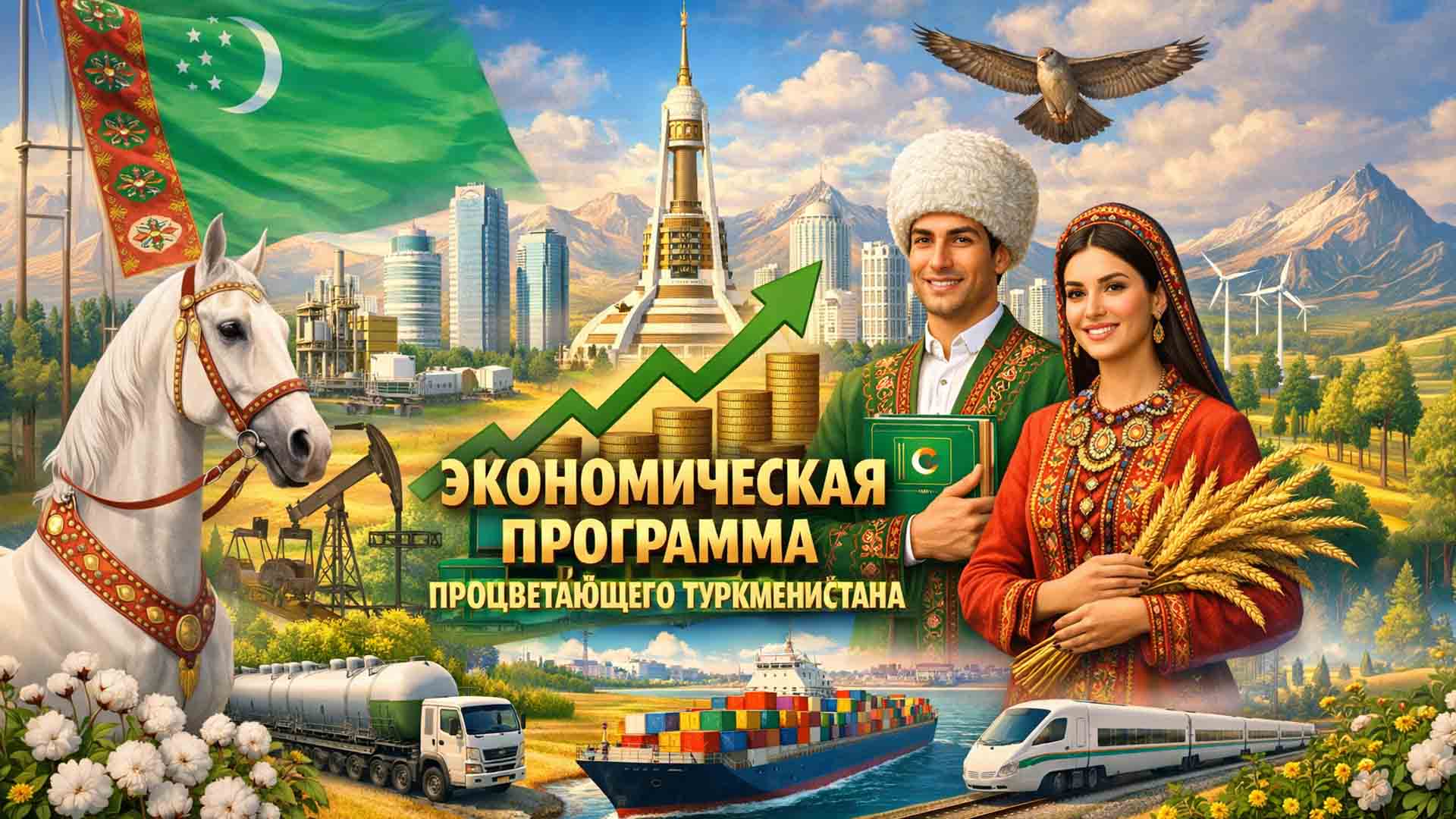
Economic Program for a Prosperous Turkmenistan
Introduction
Rapid economic growth in Turkmenistan in the coming years is not only possible but vitally necessary. To achieve it, a sober and honest assessment of the country’s starting conditions, an understanding of its competitive advantages and systemic constraints, and a clear, realistic action plan are required. This program is an attempt to form a holistic vision of Turkmenistan’s future as an open, economically developed, and socially just state.
Key Advantages of the Country
- Favorable climate allowing for two full harvests per year.
- Richest reserves of natural resources, primarily natural gas.
- Cheap energy as a basis for competitive production.
- Relatively cheap labor force.
- Demographic structure favorable for an economic leap: high birth rate and a low share of the elderly population.
Systemic Constraints
- Authoritarian management model strictly limiting human rights and freedoms.
- Closed nature of the country and actual self-isolation from the outside world.
- Total corruption.
- Remnants of the socialist model of economic management.
- Weak logistics and unresolved problems in transporting raw materials and products.
- Acute shortage of irrigation water, which will intensify.
- Mass poverty of the population.
- Information vacuum and unreliability of official statistics.
- Lack of a freely convertible national currency.
Strategic Path of Development
The only possible way forward is the simultaneous use of advantages and systemic overcoming of constraints:
- Democratic reforms, eradication of total theft and corruption, openness of the country and economy, and attracting investments. This is the foundation without which progress is impossible. Otherwise, as has been common in recent years, everything will be stolen and taken abroad. There will not be enough resources for necessary reforms.
- Market reforms. An agro-reform is needed to remove socialist remnants in agriculture that hinder its growth. Replace the existing “administrative-planning” system with an infrastructure of state operators and normal commodity-money relations followed by demonopolization and privatization of state operators. On this basis, eliminate “gray” and “black” farming and reporting fraud (pripiska). Currency rate reform and transition to manat convertibility. Ceasing planning “from the achieved,” shifting industry from speculative plan fulfillment percentages to meeting population needs. The main criterion for enterprise performance should be profit for shareholders and wages for workers, removing all administrative restrictions on producing goods people need. Development of market infrastructure — a network of commodity and stock exchanges, wholesale and retail trade, commercial banks. Attracting foreign investment.
- Orientation of state policy towards raising real population incomes. The two main drivers of Turkmenistan’s accelerated development are exports and growth in domestic consumer demand. Rising wages and pensions must be an unconditional priority of state policy. These will be the stimulus for the return of Turkmen citizens from foreign labor emigration and will become the basis for the development of the Turkmen economy. This is a key indicator of the economic program’s success and the sustainability of the Turkmen economy.
- State industrial policy aimed at:
(1) Overcoming transport constraints, primarily the construction of gas pipelines in all directions (West – Trans-Caspian pipeline, East – expansion of the pipeline to China, as well as to Uzbekistan, Kazakhstan, and Kyrgyzstan, South – TAPI (to Pakistan and India), to Northern Iran). Development of transit road and rail routes (“North-South,” “China-Persian Gulf”).
(2) Rapid development of domestic energy- and labor-intensive production. With active attraction of foreign capital. This involves the development of gas processing and gas chemistry, oil refining and petrochemistry, the construction materials industry (very necessary to reduce water losses in irrigation canals), ferrous and non-ferrous electrometallurgy, machine building, especially electric vehicle manufacturing. And finally, the development of the ultra-energy-intensive crypto industry, construction of a Turkmen crypto city, and creating and expanding a Turkmen crypto reserve.
- Water. It is necessary to reduce losses in irrigation canals as soon as possible, including by concreting their bottom and walls, and transition to new economical irrigation technologies. Water losses in the sands are enormous, meaning the potential savings reserves are colossal. Without such work, the Turkmen economy will collapse in 5-10 years. But it will require huge investments (estimated at no less than $5 billion). A reform of the existing interstate water intake coordination organization (ICWC) is necessary, involving and then including Afghanistan. Reconstruction and construction of new systems to provide the population with safe drinking water.
Assessment of the Current State of the Economy
Unfortunately, most important statistical data in Turkmenistan is closed, and the rest does not inspire much trust (large-scale pripiska). Therefore, it is very difficult to make full calculations for the socio-economic program; often, fairly rough estimates must be used. Furthermore, the lack of market exchange rate formation for the manat complicates all international calculations and comparisons.
We proceed from the following realities:
- Population.
Officially – 6.2 million people.
According to our estimates – 3.7 million.
The remaining 2.5 million people live abroad for various reasons (mostly labor migration). This is more than half of the country’s working-age population.
- Manat Exchange Rate.
Officially – 3.5 manat/$. Market rate (“black” market in Ashgabat) – 19-20 manat/$ (sometimes up to 30).
The difference – more than 5 times.
- GDP.
Officially – $45 billion.
To maintain convertibility and hold the manat, the authorities exchange dollars at the market rate and inject them into the economy through the Central Bank of Turkmenistan. Considering the market manat exchange rate, “real GDP” is – $12-20 billion. The currency valuation of GDP is overstated several times. Official GDP contains colossal scale reporting fraud across all indicators. Additionally, there is a strong corruption distortion of GDP due to underpricing export deals and overpricing import deals to move money abroad. In reality, the country’s trade balance is significantly higher than officially shown. GDP does not account for colossal volumes of cash currency transactions: from foreign trade to “gray” money transfers home by labor migrants (to avoid disadvantageous exchange at the official rate).
- GDP per Capita.
Officially – $7.3 thousand. This is lower than in Kazakhstan but higher than the other three Central Asian countries. At the market rate and our population estimate – $2.1-2.8 thousand. The official figure is overstated 3 times. Turkmenistan is among the poorest countries in Asia. It is richer than neighboring countries like Afghanistan, Kyrgyzstan, and Tajikistan, but poorer than Uzbekistan, Kazakhstan, Iran, Azerbaijan, and Turkey.
- Life Expectancy.
Officially – 67.5 years, our estimate – 57 years.
Turkmen authorities’ reports on GDP growth do not correspond to reality. They are based on total reporting fraud ranging from the number of people living in the country to harvest sizes and plan fulfillment percentages. In fact, the economy is not growing but, at best, stagnating, treading water, which with a growing population means the country is becoming impoverished. Even the IMF and the World Bank quite rightly refused to accept the country’s official statistics for cross-country comparisons.
Saving Turkmenistan. People First
A colossal, carefully hidden problem of the Turkmen economy is unemployment. Officially it is minimal, but in fact, it burns society from within.
Today’s economic system does not offer enough jobs to occupy and feed the country’s growing population. As a result, millions of Turkmen are forced to go work abroad. The surplus labor force exerts pressure, reduces wages, and people staying in the country live in poverty. Sometimes they are forced into criminal acts for survival, for which the government punishes them harshly. Prisons are overcrowded; the country is 3rd in the world in the number of prisoners per capita.
The economy must offer its population a sufficient number of well-paid jobs. Turkmen citizens should have the opportunity to return home, live with their families, and have a decent job. This is the key to the future sustainable development of the country and the basis for solving current problems.
Turkmenistan’s Water Dependence: Rising Risks and Systemic Crisis
Turkmenistan depends on water resources to a greater extent than other Central Asian countries. From the Soviet Union era, the country inherited the Karakum Canal (“Karakum River”), which to this day meets the state’s main water needs, including for the population, agriculture, and industry. However, in recent decades, the established water use system has begun to change rapidly. Today, there are at least four key problems that are radically transforming the traditional situation and creating serious long-term risks for the country.
- Increasing Need for Water
Turkmenistan’s water needs will inevitably increase. This is due to population growth, urbanization processes, industrial development, and rising living standards. Without modernization of water infrastructure and effective resource management, consumption growth will intensify the shortage.
- Reduction of the Amu Darya River Flow
A key factor of the water crisis is the decrease in the flow of the Amu Darya River as a result of global warming and the melting of Pamir glaciers. Over the past 40 years, the average flow volume has decreased by about 10 cubic kilometers, which is about one-seventh of the previous volume. According to calculations, in just 10 years, the annual flow of the Amu Darya will be less than the current intake volumes. This means an inevitable reduction in water consumption, and the water shortage will primarily affect Turkmenistan as a downstream state and its last major consumer.
- Emergence of a New Water Consumer — Afghanistan
The situation is further complicated by the emergence of a new major water consumer upstream of the Amu Darya – Afghanistan. The Qosh Tepa Main Canal under construction, which is predicted to reach full capacity in about five years, will significantly change the region’s water balance. The canal is expected to take up to 10 cubic kilometers of water per year, leading to a 15–20% reduction in water entering Uzbekistan and Turkmenistan. Thus, the water intake limit distribution system among the five Central Asian countries, formed over the last 30 years, will effectively be destroyed.
- Critical Situation with Access to Drinking Water
Access to safe drinking water remains a separate and extremely acute problem. This is an issue that can no longer be postponed, as the health of the population, environmental conditions, and quality of life directly depend on its solution. Turkmenistan shows the worst indicators among Central Asian countries: only 60.4% of the population has access to safe drinking water, compared to a regional average of 87%. In rural areas, the situation is near catastrophic – two-thirds of the population lacks such access, amounting to about 2.3 million people. In cities, about 70% of the population receives water from centralized supply systems 24/7, while the rest faces long interruptions lasting 6–8 hours per day. In rural areas, the average duration of water supply does not exceed 6 hours per day.
The situation with wastewater disposal, sewage treatment, and sanitation is even more complex. Sewage is often either not treated at all or undergoes minimal treatment and is discharged into lowlands near settlements, causing serious environmental damage and aggravating sanitary risks. Thus, there is a very short period, literally the next 5 years, during which the country must prepare for new conditions—a sharp reduction in water inflow. At the same time, it must ensure greater population access to high-quality drinking and domestic water, as well as meet the needs of growing industry.
You see what is happening to the Aral Sea; it was once a sea, and now it is simply gone. Turkmenistan is the last consumer in the Amu Darya queue (only the Aral is downstream). If urgent action is not taken, Turkmenistan faces the fate of the Aral. And not in some distant future, but literally in 5-10 years.
The current Berdimuhamedov regime refuses to see these changes. It literally buries its head in the sand to avoid seeing the problems. It spends money anywhere but on solving the priority problems facing the country’s economy. This regime must be changed as soon as possible.
The country’s economy can still be saved, but action must begin right now, without delay and without wasting colossal sums on empty, unnecessary projects.
Priority Social Program
We plan to start reforms by solving key problems facing people. This is both to demonstrate the main direction of our actions to everyone and to leave ourselves no path for retreat in the struggle for a better future for our country’s residents.
- Raise the minimum wage from 1160 manat ($61) to 4060 manat ($215), i.e., by 350%, including in agriculture.
- Raise the minimum pension from 410 manat ($21.5) to 1435 manat ($75.5), i.e., by 350%.
- Raise scholarships and all social benefits by 3.5 times.
◦ If the allowance for the first child is currently 507 manat ($26.7), this amount will rise to 1521 manat or $80 (2x growth).
◦ From the 5th to the 8th child, the allowance will rise from 410 manat to 2460 manat ($130).
◦ Starting from the 8th child, the allowance will rise to 5330 manat or $280.
◦ Women awarded the title Ene Myahri (Motherly Tenderness) will receive an additional 50% supplement to their pension, child care allowance, disability allowance, and social benefit.
◦ The allowance for orphans will increase; for example, if a large family with 4 children loses its breadwinner, 2500 manat will be paid for each child. All families with more than 5 children will receive 4500 manat for each child.
Turkmen citizens, through their patient labor, have earned the right to live much better than they do now. We are confident that establishing these new social standards in the first year of reforms is possible and necessary.
The entire priority social program seems huge, but in reality, it will require $1.5-2 billion a year. For a country with official exports of $10 billion (one-third of which, over $3 billion, is “gray” capital outflow), this is not so much. That is, we can implement it only by stopping outright theft and gray capital flight. This will replenish the budget by $3 billion or 57.0 billion manat. Furthermore, a significant part of this money will return to the budget as taxes, at least another $600 million or 11.4 billion manat.
Agrarian Program
Massive reporting fraud hides the true situation in the country’s agriculture. It is in a state of stagnation, if not outright degradation. It has reached the point of food shortages and bread queues. Thus, we will soon return to a ration system like in the late USSR. And this is in a country where 60% of the population is employed in agriculture! Meanwhile, Turkmenistan inherited huge areas of irrigated land from the USSR thanks to the Karakum River, and the country is obligated to feed its own population.
It is necessary to get rid of pripiska and actually increase agricultural production by at least 2 times based on yield growth. This will sharply raise the living standard of farmers (daihans). Significantly increase agricultural exports. In terms of budget revenue, agriculture should bring in at least 30% of total revenue in the first year, and at least 60% by the 4th year. Subsequently, with industrial development, the share (but not importance) of agriculture will decrease.
What needs to be done for this?
- Reduction of Water Losses
The system of canals and irrigated lands is the basis of Turkmenistan’s farming. But the canals are in a severely neglected state; water losses are huge (up to a quarter of all incoming water), water literally “goes into the sand.” For years and decades, canals have not been cleaned, causing them to silt up; the coastal zone and even fields are overgrown with reeds and weeds; soil is contaminated and salinized. Many irrigated lands have lost their quality because saline groundwater has risen. It is necessary to clean all treatment canals and reservoirs, put them back into effective operation, and combat clogging. These water arteries will allow for increased irrigated lands and field areas.
There is much work ahead: about 1000 km of the Karakum Canal, 9.5 thousand km of diversion canals and drainage ditches to clean the land of salt, and 350 km of the Murghab River. Cleaning and partially concreting their bottom will, by our estimates, take at least 3 years and require at least $6 billion. These costs should mainly be borne by the state. They are necessary; there is no way around them, and the sooner we start implementing them, the better. Subsequently, these costs will pay off manifold through increased collection and yield of agricultural crops.
It is also necessary to introduce new irrigation technologies. According to Chinese specialists, Turkmenistan uses 42 times more water to grow raw cotton than in the PRC. The potential for water savings here is enormous.
- Agro-reform
Turkmenistan’s agriculture lives as if it were still under socialism. The state “hands down” the sowing plan, provides seeds and water, buys almost the entire harvest, sets purchase prices, and provides machinery. Thus, it completely controls the income of agricultural organizations, keeping them at a minimum level; many farms are in debt. Market relations exist here almost exclusively unofficially, in the “gray” and “black” zone on a corrupt basis (direct theft of part of the harvest or harvesting a third crop). Reporting fraud (pripiska) of harvests occurs on a massive scale (sometimes the harvest is overstated several times).
Along with the water problem, this is one of the main reasons for the stagnation of agricultural production in the country. The goal of agro-reform in the country is the transition to predominantly market relations in agriculture, removing the state as an intermediary from these relations, restoring balance in relations between producers and consumers, increasing the income of agricultural organizations, and on this basis – improving the lives of daihans.
Let the daihans understand that through their labor they can not only accumulate debts but earn well; stop interfering with them with your plans, commands, and state prices, and agriculture will flourish.
For this, it is necessary to:
- Inventory all arable lands with clear registration of their owners (long-term tenants) and those who process them. Often daihans work all their lives on lands where it is unclear who owns them, owners change, and the rent only grows.
- In each branch of agriculture, a special state operator is created. The operator of the cotton industry – Turkmenpakhta, the grain industry – Turkmenprodkorporatsiya. The state operator will build elevators and buy products from daihans at market prices. Reserves in elevators and warehouses will be updated with each harvest. Thus, a state reserve of grain and other agricultural crops will always be available.
- The state operator gives a guarantee of grain purchase to daihans, which acts as collateral for bank lending to farms. Thus, uninterrupted financing of agricultural work will be ensured. It is important to correctly build the balance of relations between all structures.
- The right to freely sell grain, cotton, and other crops, including for export, is granted to all farms. But when concluding agreements with the state operator, daihans receive a purchase guarantee and bank loans.
By the end of the first year of reforms, agriculture will increase production by at least 30%, daihans will become wealthier, and this will become the basis for the second stage of reforms—the system of state financing and state corporations is liquidated, and a transition to a normal contract system occurs. The state corporations themselves can be divided and privatized, or partially (the state reserve system) left in state ownership.
Strengthening farms will in the future build roads themselves, including access railways, as well as build housing and livestock complexes.
Based on the growth of grain production, livestock farming will develop, as well as industrial sectors associated with it—food, leather, and others.
Based on the growth of cotton production, new textile plants will be built and light industry will develop, up to the production of ready-made clothing.
Large enterprises should be built with the attraction of foreign investors and aimed not only at the domestic market but also at the export of products. But it is important that there is an orientation not only towards large enterprises but also towards small-scale production.
In a year or two, a shortage of labor resources will arise in agriculture, leading to higher wages for all daihans and income for the most professional and enterprising part of them, which will increase demand for education and in the future ensure the transition to the most modern agricultural production. It is important to ensure the retraining of teaching staff so that they teach students modern innovations in agriculture.
It is necessary to resume the work of breeding institutes in order to apply the world’s most advanced scientific developments in seeds and soil processing. These institutes exist in the country; it is necessary to provide the opportunity for their active integration into agricultural production.
Coordination of Water Management Activities
The water problem is acute in Central Asia. Countries closer to the sources have built reservoirs and must fill them with water for effective energy. But water is also needed by downstream Uzbekistan and Turkmenistan for irrigation. In the USSR, this contradiction was solved on a planned basis. After the collapse of the USSR, the five Central Asian republics created the Interstate Commission for Water Coordination (ICWC), which regulates these issues by allocating water intake quotas. It plans based on current water flows. But scientists are sounding the alarm—due to global warming and the melting of Pamir glaciers, the total water flow of the Syr Darya and Amu Darya rivers is falling noticeably. And this fall is accelerating. Over the last 40 years, it has already decreased by an average of 10 cubic km (about 1/7). According to calculations, in 10 years, the annual flow of the river will be less than the current intake volumes. And the first blow will fall specifically on Turkmenistan, as the last in line. More accurately, the first blow has already fallen on the Aral Sea—the sea is gone—but now it is Turkmenistan’s turn. The ICWC cannot solve this long-term problem, but it can and must conduct research on it. And also prepare proposals for changing the state policies of member countries. Afghanistan is not part of the ICWC in any form, yet it is capable of blowing up the water supply situation in Uzbekistan and Turkmenistan in the next 5 years. The situation could be regulated with the help of the UN Convention on the Protection and Use of Transboundary Watercourses, but Afghanistan is not a participant. The country certainly needs to be involved in discussions of regional water problems, included in the ICWC as an observer, and in the future—as a member of the organization.
Gas
Internationally recognized proven natural gas reserves of Turkmenistan at the end of 2019 amounted to 13.6 trillion cubic meters, 7.2% of world reserves. This is 4th place in the world after Russia, Iran, and Qatar. The reserves were put on the balance sheet in 2007-10, but this had little effect on production volumes—they grew insignificantly. (Data from the BP report).
Traditional reporting fraud (pripiska) was present here too. According to official Turkmen estimates, gas reserves are twice as high—25 trillion cubic meters. At the current level of domestic gas consumption, its reserves will last for 230 years. This is a huge potential that must be maximized for the country’s development today. Perhaps in 100 years gas will no longer be needed by anyone; there is no sense in sitting on colossal wealth and not using it for the benefit of the country’s people.
Despite possessing colossal gas reserves, Turkmenistan, unlike Russia, has never been an independent player in the global gas market. It bowed to Russia and then to China. This must be resolutely changed. In general terms, the country’s gas strategy may look like this:
- Expansion of the gas pipeline to China. Laying a fourth string of the “Turkmenistan – Uzbekistan – Tajikistan – Kyrgyzstan – China” gas pipeline, with a capacity of up to 30 billion cubic meters per year. Talk of a fourth line has been ongoing for years; it is high time to get to work.
Today, China is effectively the only major importer of Turkmen gas (41.7 billion cubic meters/year, more than half of Turkmen production). Gas pipeline capacities in the eastern direction can be increased by 1.5-2 times. But it is impossible to depend entirely on one buyer, as the experience with Russia showed (in 2009-10, Turkmenistan was forced to almost halve production due to disputes with Gazprom over gas transit to Europe). Moreover, in such a situation, the buyer dictates the gas prices.
- Lobbying at all levels for the laying of the TAPI pipeline (Turkmenistan-Afghanistan-Pakistan-India). The project has existed for many years; its capacity is 33 billion cubic meters per year. All countries are interested in its construction. The biggest problem is stability in Afghanistan. But it is highly interested in the smooth functioning of this pipeline: doing nothing, just from gas transit, it will receive about $0.5 billion per year. At the same time, Turkmenistan should not invest in this pipeline as the main investor; risks should be shared with other countries and international oil companies. If investors are found, the project can be implemented in 3-4 years. If successful, it could subsequently be doubled.
- Trans-Caspian pipeline. For a long time, it was impossible due to disputes over the status of the Caspian Sea. But these problems have been resolved for several years. There was a dispute with Azerbaijan over oil and gas fields in the Caspian Sea. But 2 years ago, this issue was also settled. All participants are very interested—Azerbaijan, Georgia, and Turkey will receive large amounts of money for transit, and the gas crisis in Europe will last for many more years. Turkmenistan’s leadership stated its readiness to supply gas to Europe. But that was the end of it. There is no project, no administration, and no substantive negotiations with investors on this topic, although occasional non-binding negotiations have been ongoing for more than 15 years. One gets the feeling that Erdogan is more interested in this project than Turkmenistan. Without an active position from our country’s authorities, the matter will not move forward. The latest announcement from the country’s government: they plan a 300 km pipeline with a capacity of 30 billion cubic meters, costing $5 billion. This is not ambitious enough. Opportunities must be found to increase supply volumes to the West to match supply volumes to the East, i.e., increase them by at least double.
- The gas pipeline to Russia and further to Europe (“Central Asia – Center”) with a capacity of more than 60 billion cubic meters, built during the USSR, is practically not used today. It was not profitable for Gazprom to transit Turkmen gas when there was a surplus of its own. At the same time, it is quite realistic to continue seeking compromises and solutions with Gazprom, using it at least partially for intermediate consumers (Kazakhstan, Uzbekistan). Recent events give reason to expect the resumption of this pipeline’s operation (given Europe’s rejection of Russian gas, the resumption of Turkmen transit has become quite realistic). Here the entire infrastructure is ready; it doesn’t need to be rebuilt.
- There are 2 gas pipelines to Northern Iran. Currently, swap gas supplies go there (Iran pays for them with similar supplies of its gas to Azerbaijan). But supply volumes are small (less than 1 billion cubic meters per year). Partly due to unresolved disputes over payments for past gas supplies. This issue should be quickly settled and the geography of swap supplies expanded—Turkmenistan to the north of Iran, and Iran similar volumes to Pakistan and possibly India through the partially built pipeline. Or after gas liquefaction in southern Iran—to the markets of China, India, and other countries. Such proposals have already been publicly voiced by Iran. The possible volume of such supplies is over 35 billion cubic meters. But the infrastructure here is not finished—the Pakistani section of the gas pipeline from Iran (Iran is trying to legally force Pakistan to finish it), gas liquefaction plants. It is worth making this not an alternative to the TAPI pipeline but an addition to it. Because it is unclear when or if the Pakistani section will be finished. Gas liquefaction plants have not yet been started. Moreover, disputes in international courts regarding payment for Turkmen gas supplies to Iran (though seemingly won, but mutual settlements have not yet been made) do not make Iran a long-term reliable partner.
- A completely shameful story with the flaring and colossal methane emissions into the atmosphere. This made Turkmenistan the world leader in the number of methane emission cases in 2022—more than in the USA or Russia, which produce dozens of times more gas.
- The problem lies not in resources or objective constraints, but in managerial negligence and deliberate eyewash by the heads of state companies “Turkmengaz” and “Turkmennebit.” This is an artificially created crisis that can be eliminated promptly and without any additional costs, provided the imitation of management ceases.
- We need to expand the volumes and geography of liquefied gas supplies via the Caspian Sea, by rail, and even by road (a project for such supplies to Pakistan exists). The existing gas liquefaction capacities (“Naip GPC”) are currently used at no more than 1/4. We must more actively engage in marketing and sales of liquefied gas for export.
- The existing 5 gas processing plants in the country are clearly insufficient. It is profitable for Turkmenistan to export not just gas, but products of its deep processing. It is necessary to increase gas processing capacities (currently less than 20 billion cubic meters) by at least double. And in the future—by double again.
- As shown by the cold in the winter of 2023, Turkmenistan needs spare gas production capacities and gas storage facilities. This is necessary so that during the period of peak “blue fuel” consumption by its own boiler houses, Turkmenistan does not have to violate its international obligations on gas supplies, which neighboring Uzbekistan and Iran complained about and China noted. On the contrary, in such circumstances, Turkmenistan should come to the aid of neighbors, rather than causing their dissatisfaction by reducing export supplies. There are currently no large underground gas storages in TM.
- A connector pipeline in the Caspian (this is not a full-scale Trans-Caspian pipeline) that can connect the Azeri-Chirag-Guneshli offshore gas fields in Azerbaijan and Livanov Bank in Turkmenistan. The project cost is estimated at $400-600 million. It would be a wonderful first step before building the Trans-Caspian gas pipeline.
Oil
Proven oil reserves are small, amounting to 0.6 billion barrels (100 million tons). They cover Turkmenistan’s current needs. Reserves have not changed since the early 90s. Current oil exploration is at a minimal level, only replenishing produced reserves. The reserve horizon has been held at around 7 years of production for decades. This is low; you should have reserves for at least 12-15 years of production to demonstrate the possibility of ROI in their development. At the same time, oil production in the country must be doubled. And count on a significant (1.5-2 times) increase in production. It is necessary to strengthen geological exploration by inviting foreign specialists who understand the possibilities of the most modern oil production methods.
Oil refining. Currently, less than half of the existing capacities are used. Moreover, less than half of the produced oil goes into refining. The rest is exported, which is not good. We should export not crude oil, but petroleum products, especially since today’s oil refining capacities allow it. With an increase in oil production, it will be necessary to increase refining capacities as well. Furthermore, it is necessary to deepen oil refining and transition to the development of petrochemistry.
Manufacturing and Energy-Intensive Industries
It is necessary to fully use the potential of cheap energy and develop energy-intensive industries in the country. Primarily, this refers to the following areas:
- Gas processing and gas chemistry,
- Oil refining and petrochemistry,
- Production of construction materials,
- Ferrous and non-ferrous electrometallurgy,
- High-processing degree chemical production.
The lack of significant domestic bauxite reserves is not a critical constraint. With cheap electricity, active development of aluminum production based on tolling raw materials is possible—similar to the practice widely used, for example, in Russia. Energy cost savings largely compensate for raw material transport costs.
A similar approach can be applied in electrometallurgy with the production of ferrous and non-ferrous metals. In conditions of a global energy crisis, Europe and the USA are consistently phasing out energy-intensive industries. Turkmenistan should use this moment and purposefully attract such enterprises to its territory. At the same time, this should exclusively involve modern productions that meet high environmental standards. The country’s territorial possibilities allow for placing new plants far from major population centers on lands where there is virtually no permanent residence. Simultaneously, it is necessary to develop local housing and social infrastructure, as well as use the shift-work (vahta) method where economically justified.
Cheap electricity also opens up the opportunity for Turkmenistan to become one of the regional centers for cryptocurrency mining. This direction is capable of attracting advanced technologies to the country, as well as highly qualified specialists in electronics, IT, and programming. In the future, Turkmenistan can occupy a prominent place on the world map of the crypto industry.
The creation of modern productions from the very beginning must be carried out with the mandatory participation of foreign investors. For this, it is necessary to actively develop free economic zones, concession mechanisms, and production sharing agreements. In particular, it is possible to launch a project for a new “financial city” in a desert zone—with a preferential tax regime and comprehensive development of financial infrastructure, including a stock exchange and the crypto industry.
The development of a domestic metallurgical base will become the foundation for subsequent growth in machine building. From the very beginning, it is advisable to focus on the most promising areas, specifically on the production of electric vehicles. And this with an eye not only on the domestic market but also for export to neighboring countries: Iran, Afghanistan, Pakistan, Central Asian states, as well as southern regions of Russia.
To optimize costs at the first stage, focus should be on the production of two or three basic models: one for private consumers, another for small businesses and agriculture. Simultaneously, it is necessary to develop a network of electric charging stations, primarily based on environmentally friendly energy sources—solar and wind. In the future, such infrastructure should cover not only Turkmenistan but also neighboring states.
The implementation of this development program will require a significant number of engineering and technical personnel. This, in turn, will give a powerful impetus to the development of the education system and the creation of high-paid jobs. Investments in education must begin now so that by the time the economy “matures,” the country has a sufficient number of trained specialists.
Tourism
Democratic reforms and economic development will sharply increase interest in Turkmenistan globally. Recently, a lot of money has been invested in tourism infrastructure, but there is practically no return, as the country remains closed with many difficulties for tourists entering and leaving, poor internet, and extremely weak information support.
Advertising of ancient Turkmen landmarks and modern recreational services is necessary. Further development of the entire tourism infrastructure. This requires both direct contracts with leading world travel agencies and the active development of the P2P sector, i.e., providing accommodation and other services directly between citizens of Turkmenistan and foreigners. The tourism industry should bring the country not only a lot of money but also a new reputation as an interesting, open, and democratic country. Visiting Turkmenistan should become fashionable in the world.
What kind of tourism development can we talk about now if basic tourism entry infrastructure simply doesn’t exist? In the ranking of the world’s most welcoming countries (Welcoming Countries Rank-2023), Turkmenistan, along with North Korea and Afghanistan, occupies the last, 82nd place with a zero result: there is no visa-free entry to these countries. Analysts from the Canadian company Arton Capital calculated how many countries’ citizens a specific state accepts without a visa or with a visa issued upon arrival.
For comparison, neighboring Uzbekistan is in 25th place, allowing visa-free entry to citizens from 139 countries. Kazakhstan – in 54th place (77 countries).
For visa-free visits, citizens with a Central Asian passport found available:
With an Uzbekistan passport – 59 states (83rd place in the ranking), with a Turkmenistan passport — 52 (90th place) according to the world passport index data.
Tajikistan — 83 countries, 59th place,
Kyrgyzstan — 89, 63rd place,
Kazakhstan — 68, 75th place.
Openness of Economic Data
According to The Open Data Inventory (ODIN), Turkmenistan in 2022 occupies the last 192nd place out of 192 countries. It is the most closed country in the world, which does not want to report anything about itself not only to international organizations and other countries but also to its own population. In 2021, the International Monetary Fund (IMF) and the World Bank (WB) refused to accept Turkmenistan’s statistics due to lack of reliable information and excluded the country (along with Venezuela) from all cross-country macroeconomic aggregators. After GDP growth estimates for Turkmenistan in 2020 radically diverged: the IMF estimated growth at 0.8%, official authorities – 5.9%. Statistical data must be open, and calculation methodologies must be brought in line with world practice. We must precisely understand what is happening with people and the economy; this is a necessary condition for moving forward.
WTO Accession
In July 2020, Turkmenistan received observer status in the WTO, and in February 2022, when the country applied for full membership, it received “acceding country” status (“active observer”). But let there be no illusions: Turkmenistan is absolutely not ready for WTO accession: wild imbalances in export goods prices, which are heavily distorted by both the exchange rate and state prices and subsidies, unclear foreign trade and customs policy, a closed budget, corruption, and discriminatory access for companies to foreign trade. We will have to fix a lot, not only in foreign trade policy but also in the internal economy, transition to market prices for agricultural products, and give clear orientations for these prices through the development of organized trade (exchanges, etc.). Without this, no one will accept Turkmenistan into the WTO.
Striving for WTO accession will require greater openness, equal rules of the game for all exporters-importers, and getting rid of the rudiments of socialism and clannishness in the economy. This is exactly the path we choose, and we will follow it with all firmness. Prompt accession to the WTO is our clear goal. It will be the test of market reforms in Turkmenistan.
FATF
FATF is the Financial Action Task Force on Money Laundering. It was established by the G7 with the participation of the European Commission in 1989. Currently, FATF consists of 37 jurisdictions (countries). FATF develops recommendations for state policy on combating the laundering of criminal money and regularly assesses various countries on the criterion of following these recommendations. For countries ignoring FATF recommendations, black and gray lists are created. For normal trade with developed countries, it is very important not to fall onto these lists.
Turkmenistan is not a member of FATF. It was included in the FATF gray list and managed to get off it in 2012 with Russian lobbying. However, the issue of the country’s compliance with FATF requirements is still in the stage of assessment and discussion. It is in the risk zone. For the country’s development and the fight against crime and corruption, it is certainly necessary to more actively implement FATF principles into Turkmen financial and banking legislation.
Foreign Investment in Turkmenistan
Understanding neutrality in foreign policy as self-isolation hits the country’s economic growth opportunities hard. Turkmenistan practically does not invest abroad. The country participates in only two regional foreign investment projects: the construction of the Belarusian-Turkmen Trade House, uniting clothing manufacturers in 2020, and the modernization of the “Maryazot” chemical plant involving engineering companies GIAP from Russia. These are tiny, incidental projects.
Turkmenistan practically does not import foreign investment. There is only one major project to develop a field in Turkmenistan for hydrocarbon extraction worth about $9.4 billion with the Chinese corporation CNPC. The extracted gas goes via pipeline straight to China. Other projects are also tiny and incidental. Russia invested $1 million in the country, and Turkey — $23 million.
The format of incidental investments into and out of the country is unacceptable. It shows a lack of understanding of the strategic path of Turkmenistan’s development and the need to attract new investments and technologies. Fear of everything new stops the country’s development. It is necessary to clearly highlight priorities for attracting foreign investment into the country by industry and territory, providing special investment regimes: free economic zones, concessions, production sharing agreements, etc. And also more active participation in investment projects on the territory of other countries.
Turkmenistan: Path to the Future (Conclusion)
Turkmenistan has everything to become a rich, prosperous country. Moreover, it is the people living in it who should be rich, not the state. This is the goal of our long-term socio-economic program. For implementation, it is necessary to focus on solving the two most acute problems facing the country: returning Turkmen citizens home with the provision of decent work and solving the water complications, which are becoming increasingly loud. Simultaneously, it is necessary to lay the foundations for the country’s future economic policy—honest, effective, and carried out in the interests of the people, not thieves entrenched in power.
We know how to do this and are full of desire to take up this work.
Reference. Access to Drinking Water and Sanitation
Source: Report of the Eurasian Development Bank (EDB)
Access to Safe Drinking Water
In Turkmenistan, the worst indicator of access to safe drinking water among all Central Asian countries was recorded — only 60.4% of the population has such access. In rural areas, the situation is catastrophic: about two-thirds of the rural population is not provided with safe drinking water, which is approximately 2.3 million people. For comparison, on average in Central Asian countries, 87% of the population has access to safe drinking water. At the same time, the tariff for drinking water in Turkmenistan is one of the highest in the region — about $0.5 per cubic meter, whereas in Uzbekistan it is $0.11–0.25 per cubic meter.
Condition of Water Supply and Disposal Systems
Most water supply and disposal systems in Turkmenistan were built during the 1950s–1980s. The length of water supply networks in cities is 16.8 thousand km, disposal networks — 2.8 thousand km. The actual service life of the network economy significantly exceeds regulatory indicators and is more than 50 years. Infrastructure wear leads to a decrease in drinking water quality and to extremely high transport losses, which reach 45% or more.
About 70% of the urban population receives water from centralized supply systems 24/7, while the rest receive it with long breaks lasting 6–8 hours per day. In rural areas, the average duration of water supply does not exceed 6 hours per day.
Sanitation systems function only in the country’s largest cities. The volume of discharged wastewater is only 35% of the volume of water supplied by centralized systems. In provincial and district settlements, except for the city of Mary, wastewater is diverted outside the settlements and discharged into natural depressions, which poses a serious threat to the environment and public health.
Tariff Policy and Regulation
Until 2018, water for domestic and drinking needs was provided to the population for free. Costs for the construction, reconstruction, and operation of water supply systems were covered by local and state budgets. Industrial water supply was carried out on a paid basis in accordance with established tariffs.
Exceeding water intake limits, as well as the discharge of untreated industrial wastewater, are subject to fines. In January 2018, benefits for water, gas, and electricity were abolished in Turkmenistan. From January 1, 2024, the tariff for domestic and drinking water for the population was increased from 0.5 manat per m³ to 1.0 manat per m³. At the same time, fees for wastewater disposal services are still not collected from the population.
International Obligations and Sustainable Development Goals
On September 25, 2015, at the UN General Assembly, all Central Asian countries signed the final document of the summit and pledged to implement the Sustainable Development Goals, specifically SDG 6 — “Ensure availability and sustainable management of water and sanitation for all.” National development strategies were linked to achieving corresponding indicators.
According to estimates, Turkmenistan will be able to reach SDG 6 indicators in the field of water supply and sanitation provided that in 2025–2030, centralized water supply systems cover 93% of the urban and 82% of the rural population. This means that at least 95% of the urban and 75% of the rural population of the country must have access to safe drinking water.
At the same time, official statistical data on the actual access of the population to centralized water supply services are absent, as is information on real and planned capital investment volumes. Therefore, expert estimates are used as a baseline.
Investment Needs and Funding Gap
According to experts, in the period 2024–2030, Turkmenistan will require at least $500 million in investments to renew assets and fixed funds of water supply and disposal enterprises, as well as for the construction of new facilities. The total volume of investment for the entire period under consideration is estimated at approximately $4 billion. Considering additional costs for improving the operation and maintenance of water supply and disposal systems, the funding requirement may increase to $4.5 billion.
The funding gap for achieving SDG 6 goals in Turkmenistan is estimated at $150 million per year, or $900 million for the 2025–2030 period.
Possible Sources of Funding
Central Asian countries face a common challenge — searching for sustainable sources of funding for the water supply and disposal sector. Among the many solutions considered in the study, three key directions can be identified that can attract the necessary investment. First, reducing the gap is possible through more active attraction of financial resources from international financial organizations, multilateral development banks, and development agencies (IFOs). Second, the water supply and disposal sector in Central Asian countries needs private investment and the participation of major players. This requires not only a change in the ownership and management structure but also the creation of institutional conditions for the effective functioning of market mechanisms. A key element in this context is the development of public-private partnerships, primarily in the form of concessions.